
Sleep Apnea: India’s Silent Epidemic – Underdiagnosis, Low CPAP Adoption, and Critical Awareness Gaps in Respiratory Health

On 13 March 2026, the world observed World Sleep Day under the theme “Sleep Well, Live Better,” a powerful reminder that good sleep matters for metabolic, cardiovascular, and neurocognitive health. In India, however, this message carries urgent weight. Obstructive sleep apnea (OSA) has emerged as a silent epidemic, largely invisible because of widespread underdiagnosis, financial barriers to treatment, and profound gaps in public and professional awareness. With a population of 1.4 billion and a rapidly rising burden of non-communicable diseases (NCDs), untreated OSA is silently amplifying India’s twin epidemics of diabetes and cardiovascular disease. Recent polysomnography (PSG)-based data paint a sobering picture: prevalence far exceeds earlier estimates, yet most cases remain undetected and untreated.
The Scale of the Problem: Prevalence Data from India
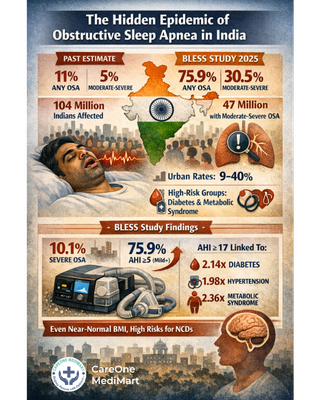
Until recently, OSA prevalence in India was estimated at 5–11 %. A 2023 systematic review and meta-analysis of eight studies (n=11,009 adults) reported a pooled prevalence of 11% for any OSA (AHI ≥5 events/h) and 5% for moderate-to-severe OSA (AHI ≥15), translating to approximately 104 million working-age Indians affected, of whom 47 million have moderate-to-severe OSA. Urban rates range from 9–20 %, rising to 30–40 % in high-risk groups such as those with diabetes or metabolic syndrome.
A landmark 2025 study from the BLESS cohort in central India upended these figures. Using Level-1 PSG (the gold standard) on 958 apparently healthy adults (median age 40 years, median BMI 23.5 kg/m²), researchers documented an astonishing 75.9 % prevalence of at least mild OSA and 30.5 % (95 % CI 28–34 %) for moderate-to-severe disease; severe OSA (AHI ≥30) stood at 10.1 % (95 % CI 8.3–12 %). Even more striking, the upper quartile of AHI (≥17) was independently associated with diabetes (OR 2.14), hypertension (OR 1.98), and metabolic syndrome (OR 2.36). These associations held after adjustment, underscoring OSA’s role in India’s NCD crisis. Notably, the cohort’s near-normal BMI highlights that craniofacial anatomy, genetic predisposition, and urban lifestyle factors drive OSA in non-obese Indians – a profile often missed by Western-centric screening tools.
Extrapolating these recent PSG-based findings to the national level, India likely harbours well over 100 million adults with clinically significant OSA – more than 10 crore, as noted in a 2026 commentary. This burden intersects dangerously with India’s diabetes prevalence (>100 million) and hypertension epidemic, creating a vicious cycle of nocturnal hypoxemia, sympathetic overdrive, and endothelial dysfunction.
The Hidden Crisis: Massive Underdiagnosis
Despite the scale, underdiagnosis remains the norm. Global data suggest 82–93 % of moderate-to-severe OSA cases go undetected; in India, the figure exceeds 85 % among working-age adults. Only about 2 lakh sleep studies are performed annually across roughly 250 dedicated sleep-lab beds nationwide – a fraction of the need. Sleep medicine infrastructure is concentrated in metropolitan centres; in tier-2 and rural India, there is almost none. Fewer than 500 trained sleep specialists serve 1.4 billion people.
Conventional screening questionnaires (STOP-BANG, Berlin, NOSAS) perform poorly in Indian populations, where craniofacial risk factors predominate over obesity. Primary-care physicians and even many specialists rarely suspect OSA in non-obese snorers or daytime-fatigued patients. The result: millions suffer unexplained hypertension, resistant diabetes, stroke, road-traffic accidents, and cognitive decline while their respiratory disorder remains untreated. A 2026 Lung India commentary aptly asks, “Sleep testing in India: Are we missing the opportunity?” The answer is unequivocally yes.
CPAP Adoption: Cost as the Primary Barrier
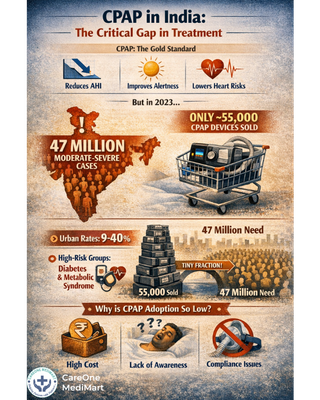
Continuous positive airway pressure (CPAP) remains the gold-standard treatment, reducing AHI, improving daytime alertness, and lowering cardiovascular risk. Yet adoption in India is dismal. In 2023, only ~55,000 CPAP devices were sold – a tiny fraction of the estimated 47 million moderate-to-severe cases.
A 2017 prospective study at AIIMS Bhopal (still the most detailed India-specific data) followed 79 patients with moderate-to-severe OSA prescribed CPAP after a free one-week trial. Overall adherence (>4 h/night on >70% of nights) was only 30.3%. Critically, 50 of 79 patients (63 %) never purchased a device; financial constraints were the decisive factor for 60 % of them. Among the 29 who bought a machine, adherence jumped to 82.7 % – higher than many Western reports.
Patients with more severe disease (higher AHI, lower nocturnal SpO₂, obesity hypoventilation) were significantly more likely to purchase and adhere (ORs 3.4–7.2). Lower family income (<₹37,000/month) and difficult titration experiences were associated with non-adherence. Out-of-pocket healthcare spending (>55% of total) and the lack of private insurance coverage for CPAP exacerbate the problem. The India CPAP market is growing rapidly (projected to grow from USD 352 million in 2025 to USD 649 million by 2035 at a 6.3% CAGR), yet affordability remains the Achilles’ heel.
Behavioural barriers – mask discomfort, perceived lack of benefit, “laziness” – exist but are secondary; when cost is removed, Indian patients demonstrate excellent long-term compliance.
Awareness Gaps in Respiratory Health
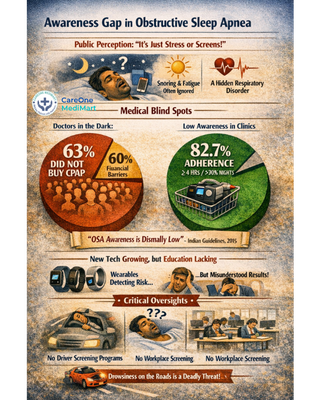
Public awareness of OSA is dismally low. National surveys show most Indians attribute poor sleep to stress, heat, or screens, rarely recognising snoring-plus-daytime-somnolence as a treatable respiratory disorder. Even among healthcare professionals, knowledge gaps persist; many cardiologists and diabetologists still do not routinely screen high-risk patients. The 2015 Indian consensus guidelines noted that “awareness among the lay public and even among primary care physicians is dismally low.” Little has changed in the subsequent decade.
Wearables (Apple Watch, Fitbit, Oura) are raising general sleep awareness, and the 2024–2025 FDA clearances for OSA risk detection may accelerate screening. Yet without structured education, these tools risk generating anxiety rather than action. Workplace and driver-screening programmes remain virtually absent, despite OSA’s proven link to road accidents.
The Way Forward: A National Respiratory Health Agenda
India stands at a turning point. The 2026 Lung India commentary calls for national practice standards, accreditation of sleep physicians and technologists, and reimbursement reform to cover validated home sleep apnoea testing (HSAT) and Level-2/3 devices. Collaboration with IITs and start-ups can drive the development of indigenous, affordable CPAP and AI-assisted diagnostics tailored to Indian craniofacial phenotypes
Policy recommendations include:
- Integrating OSA screening into national NCD programmes (diabetes, hypertension, CVD).
- Subsidised CPAP for below-poverty-line and government employees.
- Mandatory training modules for primary-care doctors and specialists.
- Public campaigns tied to World Sleep Day linking “good sleep” to heart and metabolic health.
- Large-scale longitudinal studies to quantify the economic burden of undiagnosed OSA (absenteeism, productivity loss, healthcare costs).
Conclusion
On World Sleep Day 2026, the message “good sleep matters” must resonate loudly in India. OSA is no longer a Western disease or an obesity-only condition; it is a pervasive respiratory disorder silently driving India’s NCD burden. With robust recent prevalence data showing 30 % moderate-to-severe OSA even in lean adults, >85 % underdiagnosis, and CPAP adoption crippled by cost, the time for complacency is over.
By investing in standardised sleep testing, affordable therapy, and nationwide awareness, India can transform this silent epidemic into a preventable success story. Respiratory physicians, policymakers, and the public must act together because when India sleeps better, the entire nation lives better.
References
1. Prevalence and association analysis of obstructive sleep apnea in India: Results from BLESS cohort ( Link)
2. Prevalence of Obstructive Sleep Apnea in India: A Systematic Review and Meta-analysis ( Link
3. Obstructive Sleep Apnoea in adult Population in an Urban Area of Delhi, India: A Community-Based Epidemiological StudyLink
4. Systematic review and meta-analysis of the prevalence of obstructive sleep apnea in Indian adultsLink
5. Prevalence of obstructive sleep apnea among Southern Indian pregnant women attending antenatal careLink
6. Sleep testing in India: Are we missing the opportunity?—A commentary on the need for standardisation and innovation Link
7. Prevalence and Clinical Features of Rapid Eye Movement-related Obstructive Sleep Apnea: A Cross-sectional Analysis of Clinical Population from South India (Link)
8. 104 Million Indians may be suffering from Sleep Apnea: Study ( Link)
9. India Sleep Apnea Market Size, Share and Trends Analysis Report – Industry Overview and Forecast to 2033 Link
10. World Sleep Day 2026: India’s Sleep Crisis Is Getting Worse Every Year Link
11. Sleep testing in India: Are we missing the opportunity?—A commentary on the need for standardisation and innovation Link